Well, here we are. The rapid onset of a fascist government (or at least the final ripping off of the benign mask) has most marginalized people we know reconsidering their position on firearm ownership. If you’re reading this, you’ve probably recently changed your mind as well, and might not know where to begin. Or, you might have gone out shooting with some friends, but aren’t sure yet about obtaining your own. You might even be a long-time gun owner just looking for a refresher. Let this guide be an introduction, an instruction, and a philosophy that differs from the reactionary preppers, salesmen, war stories, and fantasies where most information about firearms can be found today.
What Is A Firearm?
A firearm, or gun, or shooty mcbangbang, is a mechanical weapon that is designed to launch a projectile in a specific direction at very high velocities. This basic function can be represented by many different configurations that lend themselves to as many different applications, such as close-range engagement with side arms like pistols or handguns, or long-range engagement with long barreled rifles or long guns, and anything in between and beyond.
If you’ve never held or fired a gun before, they may seem daunting, scary, and complicated. However, like a car, though there are many different models, most guns have the same basic parts and functionality; the knowledge and operation of which can be applied across the board to safely handle these weapons. Let us go over these parts now:
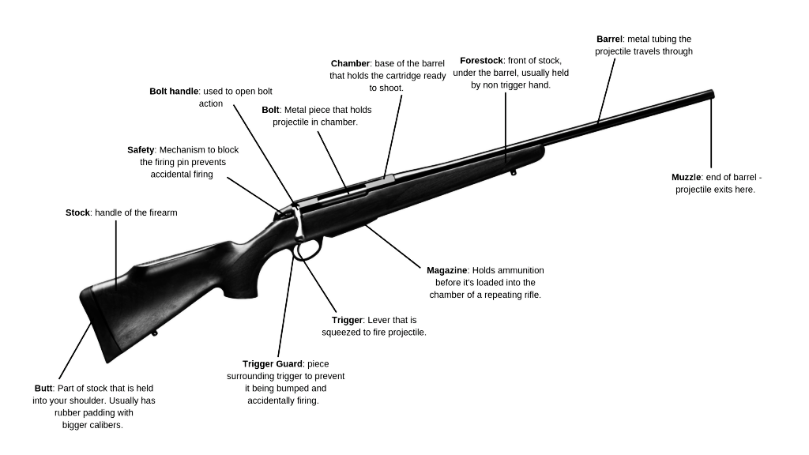
This is a bolt-action rifle. The operation of this kind of firearm means that one bullet is fired for one pull of the trigger, after which another round cannot be fired unless the bolt is pulled back by hand, and the next round is loaded into the chamber. This style of firearm is still used by hunters and precision sport shooters due to their accuracy at long ranges.
Now, let’s look at another kind of firearm which may appear to be a wholly different operation:
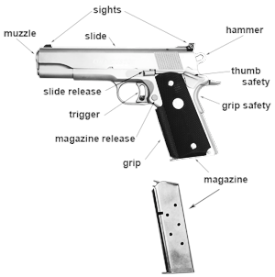
This is a pistol. While it may look radically different, we can already see some parts of the firearm that match the parts of the rifle. The chamber of this gun is inside the slide, the whole of which acts as a bolt that encases the round.
Ostensibly, all firearms have the same basic parts. A barrel to direct the bullet out of the gun, a trigger to activate the mechanism that fires a round, a safety that prevents the accidental misfiring of the gun, and a chamber that holds the round in the gun until it is fired. Magazines hold extra ammunition to be loaded into the chamber after a round is fired, and sights assist in the aiming of the weapon. The muzzle is what we call the very end of the barrel, the exact spot where a bullet exits the firearm.
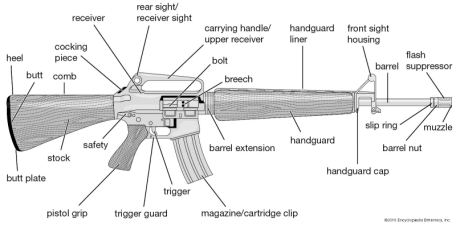
For our purposes of outlining the safe handling of firearms, we really only must understand these four terms:
Trigger, Safety, Muzzle, and Chamber
Thusly, we can now fully understand and implement the Four Basic Rules of Gun Safety:
Always treat every firearm as if it is loaded.
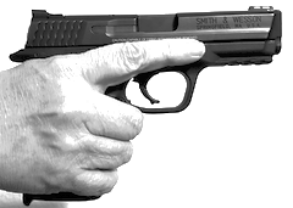
Always keep your finger off the trigger until you are ready to fire.
Always be aware of your target and what is behind it.
Always keep your muzzle pointed in a safe direction.
(Or, more viscerally, Never point your muzzle at something you are not willing to destroy)
Always treat every firearm as if it is loaded.
Can you, at a glance, determine that a firearm is loaded or unloaded? The truth is that nobody can. Unless you are able to examine the chamber yourself, or an identifying object such as a chamber flag is in use, you have no way to prove that a firearm is unloaded, or incapable of firing a bullet. This is perhaps the most important rule of Basic Gun Safety, as it informs all others, and the common sense application of which organically introduces safe behavior. We can see what happens when this rule is not followed, as in the unfortunate case of Alex Baldwin killing a worker on a movie set after firing a gun that was assumed to be unloaded. Always treat every single firearm as if it is loaded.
Always keep your finger off the trigger until you are ready to
fire.
The learned habit of keeping your finger off the trigger is called Trigger Discipline. Keeping your finger off of the mechanism which is responsible for firing the gun is the easiest and most effective way to ensure that it does not fire until you absolutely want it to. Most people do this by keeping their trigger finger outside of the trigger guard, or on the side of the firearm above the trigger. This guide recommends the latter, as it is harder for your finger to accidentally slip inside the trigger guard while in movement or stressful situations. It is all too easy for a reflex or a twitch to fire a weapon when the finger is resting on the trigger at all times. The best way to mitigate that is to simply keep your finger off the trigger until you are ready to fire. This is a habit that will take some practice, but after enough time, you’ll probably be practicing trigger discipline with spray bottles or claw grabbers without even realizing it.
Always be aware of your target and what is behind it.
Bullets travel very fast (editors note, this is an understatement). There is an immense amount of energy behind the projectiles that guns are made to fire, and as such, they will often go completely through something rather than stop inside of it. Even including the usage of expanding bullets such as hollow points or hunting rounds that are made to mushroom or balloon inside an organic target, if you miss, that bullet is going to keep going through whatever environment is around your target. Such is the case when a man attempted to drive through a line of protestors shutting down I-225 in Colorado. Someone attempted to stop the car by firing his handgun at the driver. The authors regard this as a very foolish move. Attempting to hit a fast moving target while in a stressful situation put even more people in danger than just the ones immediately in danger of being hit by the car, and in fact two protestors went to the hospital with gunshot wounds from this incident. This was an escalation that did not need to happen, which ended up harming more people than would have been otherwise. This is a rule that we will come back to throughout this text.
Always keep your muzzle pointed in a safe direction.
(Or, more viscerally, Never point your muzzle at something you are not willing to destroy)
Due to the aforementioned speed at which bullets come out of barrels, they are capable of destroying a litany of things: Locks. Cars. Power Stations. Bones. Lives.
Unfortunately, a gun can fire at anything it is pointing at. Fortunately, a gun can only fire at anything it is pointing at. The best way to ensure that nothing is fired upon which you are not intending to is to keep the muzzle of the gun away from things that you do not intend to harm. Most ranges will have you keeping your muzzle pointed either directly up, or at the ground until you are at the firing line. When on the firing line, downrange is where you want that muzzle to point at all times, including when you’re transferring your weapon in and out of a case. On other ranges, where there is only a berm to stop bullets from leaving the range, there is emphasis on not aiming any higher than that berm, or “over the hill” as some might say. Misfires do happen, and the most effective way to mitigate this is to keep the weapon pointed in a safe direction away from things that we do not wish to harm.
No firearm is inherently safe to handle. Accidents from mishandling and misfires can and do happen. There’s a reason why the .22 still causes the most gun deaths in the United States, and why the authors of this text recommend that you do not procure a Sig Sauer P320 until the company makes it stop going off in holsters on its own. However, with these four basic rules, we can do our best to mitigate the damage that may occur from improper handling of the firearm. Memorize these rules. Utilize them at the range, at home, and when handling new firearms at the gun store. They are only there to benefit us, and everyone around us.
What Is A Round?
A round, or a cartridge, is the whole shebang.
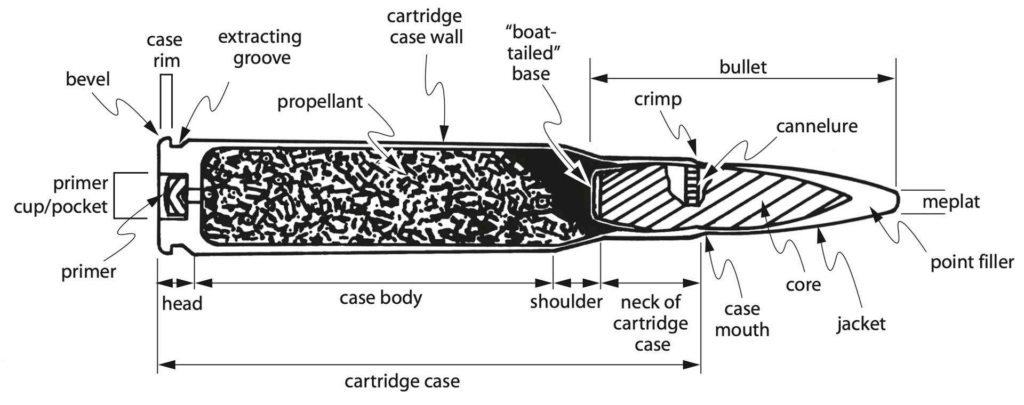
The cartridge contains everything needed to propel a projectile at high speeds. The cartridge holds:
- The primer, which is the material that is struck when the trigger is pulled.
- The propellant, which is then ignited by the primer.
- The bullet, which is the projectile forced out of the casing
- by the build-up of pressure by the burning propellant.
The bullet is the projectile being fired, and the cartridge, or round, is the entire assembly that contains the bullet and the means to propel it.
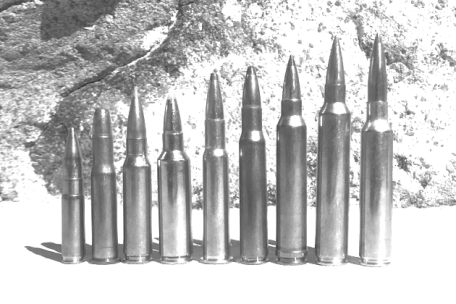
Bullets come in many shapes and sizes, and are dressed in as many different casings. The diameter of the bullet is the caliber, and many different cartridge sizes can be found within a single caliber, which all have many different ballistic behaviors. For example, the cartridges in the next picture all house bullets in .30 caliber range.
Also, it should be noted that a bigger caliber doesn’t necessarily mean a more powerful round. The 9mm Luger, which is perhaps the most common ammunition used in handguns today, has a bigger bullet than the 5.56 NATO cartridge, which is the most common ammunition used in AR-15 platforms. The latter, while having a smaller sized bullet, has more propellant in its casing. This results in a more powerful round, as with greater speed comes a greater transfer of energy.
The determination of what kind of caliber is right for you depends wholly on what kind of shooting you want to do. Some rounds are better for hunting, some are better for target shooting, some are fun for showing off, and some are designed specifically for the killing of a human being. We will not be pulling any punches or beating around the bush here. What you intend to do with your firearm is going to determine what kind of projectile you want to fire, and how it is fired.
Let us now examine perhaps the most important question:
What do you want a firearm for?
Seriously. What is it that you intend to do with the firearm that you are to obtain? We will waste no time on simple, vague answers such as “self-defense,” or “shit hits the fan” and will instead follow these reasons to their natural conclusions. Too often, because most of the means of obtaining a gun are through institutions, private enterprises, or individuals with a more conservative or reactionary framework, the only information one can get through these sources is framed in ways that mythologize individuals, fantasize scenarios and outcomes, or are simply engineered to sell you a bunch of bullshit. Too often we see even our own comrades falling into the rhetorical trappings offered up by the firearms industry and its talking heads, putting too much emphasis on individual ownership rather than collective community defense and safety.
So again we ask: What do you want a firearm for?
Hunting
We won’t tell you not to feed yourselves. However, a proper analysis of colonialism in the Americas, its impact on Indigenous hunting practices and the reality of American hunting being used as a genocidal method in and of itself is beyond the scope of this guide. We recommend that you seek out Indigenous voices about responsible hunting practices, and do what you can to combat the enforcement of American laws prohibiting Natives from hunting on their own land.
Sport/Target Shooting
Hey. Shooting guns is fun. Like a lot of fun. If you want to spend the time to discipline yourself to go for long-distance shooting and memorize ballistic coefficients, or just want to go plinking with your friends, go for it. It’s a fun and rewarding sport, so long as you treat it as such. Honestly, a .22 is probably all you need to just have a good time, and as a low-powered cartridge it is very good for introducing new people to firearms and teaching basic safety rules without them getting nervous about high recoil.
Self-Defense
Ah, here we go. This framing of firearm ownership didn’t really take off until the 1990’s. We’ve all heard the same sales pitch. The world is scary! Get a gun to defend yourself! Protect yourself and your house and your property from bad guys! But in what manner? And how effective is this defense strategy? And how ethical is it?
To the degree that a firearm is capable of preventing harm, it is only in the capacity that the explicit knowledge of a person having one may act as a deterrent, and only up until that point. Beyond that, a firearm cannot be deployed in a defensive role, such as armor, or a shield, or a security system in one’s home. A firearm can only ever be used as an offensive weapon, in response to harm or an attempt thereof that has already taken place, with the express intention of stopping the individual from being able to do further harm by any means necessary.
This is already evident in the scenarios that most proponents of this framing offer to us. The burglar is already in your house, and what if he has a gun and wants to hurt you? The bad guy with a gun has already shot multiple people, and it is up to you to stop him. You’re the action hero, going to save your family, or the town, or yourself, and you’re gonna do it with your sick ass $1,000 AR platform that you brought to Walmart! Making a soldier of every man, a defender of a million little countries!
This, unfortunately, emphasizes the individual responding to a situation where either they or their stuff is at risk, wherein a transgression has already occurred and the arms of the state are not immediately available to help (or are in fact the perpetrators of the original violence). In the case of defending against hate crimes, they’ve already sold the racists and homophobes guns, so you should buy some too! Probably from the same store!
Search up “gun for self defense” and google will return a litany of results for products you should buy. Change that query to “using a gun for self-defense” and a good bulk of the results are related to the legal ramifications of shooting someone in so-called justified homicide. The rest are studies about how guns
aren’t actually more useful than other self-defense strategies, and an analysis of the increased risks inherent to utilizing firearms for this purpose. A few links proclaiming the same vague sales pitch that you’ve heard already can also be found.
Curiously, there seems to be a distinct lack of information about how a gun could effectively be used in a self-defense scenario from either search query. Guess you’ll just have to fork over a couple hundred bucks for the NRA sponsored self-defense class to find out.
Consider rule #3 of the Basic Rules for Firearm Safety. Always be aware of your target and what is behind it. In a home invasion, can you guarantee that you will hit your target 100% of the time? What kind of ammunition can take down a person actively trying to harm you that also won’t penetrate beyond the walls of the room you’re in, or beyond your house? Is that even feasible for someone who lives in an apartment, or with children in the next room? How many burglaries even happen when people are home anymore?
According to the Bureau of Justice Statistics, only 9 out of 1,000 households were burgled in 2021, with 72% of those burglaries happening when no one was home. A gun in the home for the explicit purpose of home-defense would therefore only be useful in 0.252% of cases, with even that fraction of a percentage
going down. The Council on Criminal Justice reports that burglaries are on a downward trend, with a 26% decrease between 2019 and 2023.
Well what about combating an active shooter? If you’re in an active shooter situation, can you guarantee that you won’t harm any bystanders? Can you guarantee that you wont be designated as the active shooter by the state once you take him down? We remember how that unfolded in Arvada, CO in 2021,
when Johnny Hurley shot and killed a man attempting a mass murder of police, and who almost immediately after was shot by another cop who couldn’t have known he wasn’t the original
shooter. The perfect NRA Good Guy With A Gun got shot and killed by cops after killing the Bad Guy With A Gun who was actually killing cops, because in the eyes of the state, at the time they were both simply Men Who Are Shooting Guns At People.
So what are the hardline statistics for the usefulness of defensive gun use? According to Americanprogress.org: “When a victim used a gun defensively, 10.9 percent reported suffering an injury; when victims took no defensive actions, the rate of injury was 11 percent.” We feel that a <0.1% difference is negligible.
In fact, you are much more likely to turn the gun on yourself than you are to turn it upon someone else in self-defense. An acknowledgment of this fact is important to consider, especially if you live with people who might be at increased risk of suicide. It is warranting an important conversation as to who consents to these higher risks in their home if you live with roommates.
Let’s say you are not convinced. You still go out, you get that self-defense pistol class, you conceal carry. You are a responsible gun owner and you are ready to defend yourself and your commodities with a vengeance.
Are you truly committed to taking the life of another human being?
This isn’t a hypothetical. Or at least, it should not be treated as such. Recall rule #4. Never point your muzzle at something you are not willing to destroy. If you are going to point your gun at someone, even simply as a deterrent, you must accept the logical conclusion of that action to pull that trigger and kill someone if they are not deterred by the mere threat of violence. This is not a call for you to harden your heart for what must be done. This is not an invitation to wield incredible power in your hands. It is a fucking tragedy. This is a weight, and one that you do not have to accept if you choose not to. Take a different, more effective personal self-defense class, and read on to see what effective community defense looks like with firearms. This isn’t your only option for protecting yourself or others in this
world, no matter how much the industry of death tries to tell us it is.
The Revolution
You better be running drills and actively training with your People’s Army in preparation for a transfer of power instead of just being a lone-wolf prepper with a red or black paint job is all we’re saying. Read Guerilla Warfare by Che Guevara and get organized.
Shit Hits The Fan (SHTF)
Okay, seriously?
However you daydream and dread about what the end of the world as you know it looks like, it will be a lot more banal, gradual, and painfully contrived than you can believe. It has been that and less. And even if there was a grand dramatic civil war, you alone with your little AR-15 and your cache of ammo at
home are not going to be the ones making it out.
Do you know how to sew and mend clothes? Do you know how to grow and cook food? Do you know how to hunt and dress game? Do you know how to purify water? Do you know what to do with raw sewage? Can you build a shelter? Do you know any first aid? Can you start a fire? Do you know any games you can play without electricity? Can you play any music, sing any songs? Do you have any stories to tell the people that are with you to ease their nerves, or to inspire morale? Do you have hope for a future that you can help to build, or would you settle into an ever-enduring brutal present? Would you convince yourself that being a monster is the only way to survive in a strange new world? Do you believe that right now?
Do you know how to take care of your gun when you cannot get fresh little wipes to oil each little corner? Do you know how to make a solvent that can clean your barrel? What happens if your scope breaks, or your rangefinder runs out of battery, or your wind calculator stops working right, or you don’t have the internet to answer all your questions anymore?
If it is just you, alone in the world, trying to do all of this, keep track of all of this? You won’t last a month. The people that work together, helping each other with sharing skills and expertise, knowing that collective self-interest is the most effective self-interest, these are going to be the ones that make it. Knowing how to stay alive is so much more important than knowing how to kill people. It is fucked up that we have let them trick us into believing that those are the same thing.
Community Defense
What does one mean when they say that they’re going to call the cops on someone to get them to stop doing something? Let us rephrase that; what is being utilized when someone threatens to call the cops on someone else?
The threat that is inherent to every police interaction: Violence at the hands of the state in order to coerce behavior, whether implied or explicit.
But why the state? What legitimacy does it claim to be the only one to wield power? Why is society constructed so that we are not able to defend ourselves without permission from the state? Max Weber’s theory of the State Monopolization of Violence is the core idea that we will be addressing here, as well as examples of how to effectively deconstruct it and combat its practical applications. This philosophical analysis is the foundation of Community Defense as it pertains to the utilization of violence, whether implied or explicit.
Now first off, what is violence?
Merriam-Webster defines the word as “The use of physical force so as to injure, abuse, damage, or destroy.”
Sub.Media offers this:
“[…] Violence is generally understood as any action that causes shock or pain to another sentient being. Often it describes a direct act of force to assert agency or control over another person, but it can also be indirect, passed down through hierarchies and encoded into arbitrary sets of rules. Violence can be physical or it can be psychological… and most often, it’s a mixture of the two. When most people hear the word violence, the first thing that often comes to mind is the use or threat of physical force. Whether this takes the form of a punch to the face, a mass shooting, a domestic assault, a death threat, rape, a sensationalist news report about an armed robbery, or a debate over tactics…. this is the realm of violence that everyone can relate to, to some extent. Maybe we’ve experienced a specific manifestation of it first-hand. Maybe not. Either way, we all know what it’s like to feel pain. We can all identify with the sudden shock of unexpected danger.”
Who gets to use violence, and when? The state would have you believe that it is the only entity that should be able to use violence. For example, every single gun control bill that is introduced fails to even suggest that we disarm the police as well as private citizens. This, despite 28-40% of officers perpetrating domestic abuse against their partners, and despite current federal law disqualifying domestic abusers from gun ownership. To adhere to its own rule of law would be to disarm at least one third of the people responsible for wielding violence on behalf of the state, a reality that it would not dare to address.
We live in a society of laws. They provide a framework for society to conduct itself, a guide of behavior for, in theory, all of us to get along. An adherence to these laws is what legitimizes a state in the eyes of the people it has control over. It is an agreement: “We, the people, will set aside an amount of our personal autonomy to bestow the state, an abstract, with the power to carry out our wishes on our behalf. If the state adheres to the laws that we’ve established, we will consent to be governed by it.”
However, laws are only as applicable as they are enforceable. The authors do not believe that we are so out of pocket when we acknowledge that the only way to guarantee the enforcement of a law is to use force to coerce people to adhere to it, if they refuse otherwise.
With each logical step one can understand the conclusions of the systems that we find ourselves in. The people who make our laws are influenced not only by the people who voted them into office, but also by lobbyists from industries, gifts (bribes) from private individuals, personal politic with the power to actualize it, and an interest in preserving that power. With all this, it’s no wonder why so many laws that the people did not ask for get put into place.
Let us examine one such instance; a law gets passed that a majority of people are opposed to. A private individual decides to flaunt it, and the police respond to the behavior. If a warning does not do (what are they warning of?), fines are imposed, thereby (depending on class) threatening a person’s livelihood, or housing, or food security; all themselves acts of violence. Imposed homelessness, starvation, we don’t have to explain the damage this does to individuals or families, and the lives that it takes. When the individual continues to disobey the law, the only method left to coerce the desired behavior is direct violence. Like a mafia boss, the state sends its armed thugs to your door, demanding you to let them lock you up lest you be shot where you stand.
Violence is the only language that the state can speak to get what it wants. And it legitimizes that violence by selling us the narrative that it is the only entity responsible enough to wield it. It further enforces that narrative by inflicting its violence upon those who would attempt to stop it, and painting any violence opposed to its own as illegal and illegitimate. You can see where the mythology of individuals using firearms for self-defense stems directly from the means that the state uses to justify its existence. Brandishing firearms on the hips of its police patrols to deter behavior. When that passive deterrence does not work, the cop then points his gun at you, and the state is prepared to pull the trigger the first chance it gets.
The only difference is, the state is organized, and right now we are not.
The only way that this system can continue is that the people who actually make up the society keep consenting to the existence of the state. Perhaps the systems of capital and the violence required to enforce its progression are not enough of a threat to enough people. Comforts afforded by child labor in the global south and suicide nets outside of Chinese factories are far enough away that they do not get in the way of transactions. And after all, it’s only Black neighborhoods getting demolished for highways and getting shot in the back by cops, only Hispanic people getting thrown into vans and disappeared by masked soldiers. Only trans people having their healthcare stripped away, only poor people dying in amazon warehouses, metal foundries, and meat processing plants. Only Native People forced to live in apocalyptic conditions and having their children snatched from their homes to be adopted by settler parents, only women forced to carry a rape for nine months and give birth to it.
Only all of it. And the ways they all intersect with each other.
“The purpose of a system is what it does.”
From Wikipedia, “[This] is a heuristic in systems thinking coined by the British management consultant Stafford Beer, who stated that there is ‘no point in claiming that the purpose of a system is to do what it constantly fails to do.’” If the United States truly stood for peace, equality, and freedom, then that is what would be happening right now. Demonstrably, it is not. And a system that allows power to advance unchecked like this was always going to end in fascism. The myth of freedom and opportunity persists, despite the country having hundreds of years of slavery and segregation, forced removal and genocide of Indigenous people, concentration camps for Japanese people, structural misogyny that kept women as objects, and the perpetuation of the AIDs crisis well before a certain man was voted into office. This nation was built, and is maintained, through violence. We ought to be defending ourselves from it.
Remember, adherence to agreed-upon laws is what legitimizes a state in the eyes of the people it has control over. Well, what legitimacy can a state claim when it breaks its own laws? What happens when the contract is broken? What do we do, what can we do, after that?
One person simply brandishing a firearm at a cop to deter state violence is not going to work. You know this, we know this. One person shooting the United Healthcare CEO did a lot to freak out health insurance companies, which did result in them immediately approving more coverage, but did ultimately
nothing to effectively change the system of privatized healthcare. You know this, we know this.
Unfortunately, communities having to defend themselves without the help of the state, and even against the state itself, are not anything new. Fortunately, they fucking wrote shit down, and we can draw on these historical examples to apply what they did right, and learn from what they did wrong. You probably already have an idea of a movement that utilized firearms to defend itself from the wishes of a state, or the stochastic terrorism it employs. We’re going to start with probably the most well known.
The Black Panthers’ Armed Patrols
In 1966, The Black Panther Party for Self-Defense was founded by Huey P. Newton and Bobby Seale in Oakland California. In its original inception, the Party’s explicit goal was to record and stop police brutality against black people by the Oakland Police force, by any means necessary. Noting the inadequacies of non-violent tactics to directly address the issues of police abuses of power, and especially those tactics’ inability to stop the immediate death of black people in the moment, Seale and Newton decided to arm themselves and run organized patrols, following and observing cops who stopped black people for any reason on the street, and making sure the cops knew they had guns at their backs for as long as the stops lasted.
They understood the means of coercion through the threat of violence, and applied this threat to the state, thereby successfully preventing the death of who-knows how many people, and at the same time legitimizing themselves in the eyes of the population of Oakland, as the state had already deemed itself illegitimate by its mistreatment of black people nationwide.
The effectiveness of the armed patrols is in the fact that they were actively organized. Simply giving every individual black person a gun and having them point it out their car window for every stop is not only ineffective, but also tactically dangerous. A person sitting in a vehicle and strapped to the driver’s seat is in a much more compromised position than a cop able to maneuver however they need outside the vehicle. The presence of an external armed patrol, with an always clear line of sight to the cop performing the stop, and which potentially can outgun the officer, is a much more effective tactic. In this instance, it also greatly reduces the amount of resources required to deter violence from the state. Bobby Seale and Huey Newton had but two shotguns between them when they first started the patrols, but it was incredibly effective to deter a number of police officers from ending the lives of the black people that were subjected to the stops.
It should be noted that had this been the only effort that the Black Panthers partook in making sure their communities were safer, they would not have constituted the actual threat to the United States that they did. Violence and the threat of it is certainly a tool, one that demonstrably can be deployed effectively, but we have many of these tools at our disposal for the variety of problems that we face. It wasn’t until three years later that the Black Panthers would create their first social survival programs, such as the well-known Free Breakfast program, as well as a free ambulance, free medical clinics, and grocery distribution. It is in fact the operation of both of these programs simultaneously, the armed patrols and community care programs, that made people confident in the Party’s ability to protect them, both from the direct, physical violence of the state, and the abstract violence of poverty, starvation, and lack of healthcare. This is what is meant by a Diversity of Tactics, the organized implementation of which can successfully halt or deter a multi-faceted oppression by hitting it from many different axis at once.
Redneck Revolt at Charlottesville
On August 11th, 2017, organized fascism in the United States went mask-off. A coalition of fascists, white supremacists, Nazis, Klansmen, right-wing militias, and the budding alt-right marched on Charlottesville, VA for a rally dubbed “Unite The Right.” The aim of this rally was both to protest the removal of a statue of Robert E. Lee from a public park, as well as attempt to finally organize all the different facets of the American neo- fascist movement and get them all in one place. In the moment, this was largely successful. Around 500 fash showed up, bearing tiki torches and shouting white supremacist and neo-Nazi slogans. During the night-time march on the University of Virginia campus, a fight ensued between the fascist contingent and about 30 counter-protesters, most of which were UVA students.
The fascists took to the streets the next morning, armed with clubs, pole-arms, shields, and firearms. The day started with a non-violent demonstration from local clergy, who linked arms and sang songs of peace in the face of this. Later, Cornel West, a professor from Harvard stated “20 of us who were standing, many of them clergy, we would have been crushed like cockroaches if it were not for the anarchists and the anti-fascists who approached, over 300, 350 anti-fascists.”
Police were largely hands-off in their response, as an independent review from Hunton & Williams LLP found that “Law enforcement failed to break up fights or take an active role in preventing fights and were instructed not to intervene except in cases of ‘extreme violence.’” This left the counter-protestors to fend for themselves.
The leftist response was decentralized, made up of numerous independently organized groups. Despite the lack of inter-group communication prior to getting to Charlottesville, anti-fascists outnumbered the fash 2:1, and employed a multitude of tactics in their protest. One of these was an organized armed group called Redneck Revolt.
An off-shoot of the John Brown Gun Club, Redneck Revolt was a leftist militia with a stated goal to organize working class people away from the clutches of reactionary politics and towards a philosophy of anti-racism, anti-capitalism, and working class solidarity. A lot of their early organizing was spent tabling at gun shows, distributing leftist literature and using firearms as a common ground from which to begin conversations with the people that frequented those events, thereby educating them and pulling them away from the conservatism that is so baked into gun culture. At the same time, they sought to educate and train marginalized people in the use of firearms, and were staunch advocators of community
self-defense.
The morning of August 12th, Redneck Revolt worked with local organizers to create and maintain a staging area at Justice Park, two blocks away from the park where the Unite The Right rally was planned to take place. Armed with tactical rifles, about 20 members of Redneck Revolt secured a perimeter around the park, effectively creating a safe space for other organizers and anti-fascists to provide support to each other, including first aid, food, water, and space to rest and regroup.
During the course of the morning, the fascists had scattered through the entirety of downtown Charlottesville, employing incredible violence as they went. According to a reportback from Redneck Revolt, “At many points during the day, groups of white supremacists approached Justice Park, but at each instance, Redneck Revolt members formed a unified skirmish line against them, and the white supremacists backed down. […] Some of the groups that approached numbered as many as 40 people, but the security of Justice Park was never breached.”
Unfortunately, Redneck Revolt’s ability to defend against fascist harm stopped at the perimeter of Justice Park. Elsewhere in the city, a 20-year-old black man named DeAndre Harris was beaten with wooden planks and metal pipes by six fascists in a parking garage, and a man killed 32-year-old Heather Heyer and injured 35 others when he purposefully rammed his Dodge Charger into a crowd. Two members of Redneck Revolt ran to help with first aid as soon as they heard about the latter incident.
It should be obvious now that a coordinated effort to demonstrate the ability to apply force is a successful deterrent to the kind of violence that goes looking for what it perceives to be easy targets. Especially as hate crime rates increase, emboldened by a government that fuels and endorses it, organized efforts to secure our community spaces from the attacks of far-right stochastic terrorism and violence are more important than ever. More than saying it’s time for us to fight back, we have to be able to prove that we can and are ready to.
The tragic death of Heather Heyer and the beating of DeAndre Harris stand in stark contrast to the successful security of Justice Park. Admittedly, we do not know exactly what would have kept them safe as the swarm of 500 fascists poured through the streets of Charlottesville. Individual pockets of violence got so many people hurt even while the anti-fascists outnumbered the bigots. We think it’s certainly worth a conversation as to what went right (The organized secure perimeter of a staging area, having the training and ability to respond to traumatic events, organization and employ of tactics within a certain group, recognizing the value in adoption of a diversity of tactics and how violence can be used to defend those that are choosing non-violence) and what went wrong (small numbers within organized groups meant a narrower focus on objectives and limited ability to respond to other events, and an anxiety and apprehensiveness throughout leftist organizing circles about utilizing armed defense leading to a distrust of those that do, which ends up contributing to those smaller numbers, blindspots on being able to defend bystanders caught in the middle of skirmishes they did not go looking for).
Charlottesville was a lot of things. Looking back, it seems like it was silencing the loudest canary in the coalmine. It proved that all these different factions of the alt-right, the old-school klansmen and Nazis, and modern conservatives could work together. Certainly it was a blueprint for the organized umbrella of fascism that the current administration is implementing through the authorship of the Heritage Foundation’s Project 2025. We think it was also a teaching moment for us, and one that needs to be revisited.
Stopping a mass shooting in Portland
On February 19th, 2022, June “T-Rex” Knightly was killed and 4 others were shot by Benjamin Smith in Portland, Oregon. An armed activist named Hope was able to stop Smith by firing two rounds into his hip using a rifle.
June and her friends were corkers, volunteer mobile barricades to direct traffic away from running into protests and street marches. This particular night was for a protest against the police killings of 27-year-old Patrick Kimmons and 22-year-old Amir Locke. After a pre-meeting with other corkers, Hope, and a medic named Cass, the latter two returned to their car up the street from where June and the other four were staged and getting ready to leave. Smith walked up and started a verbal altercation with some of the volunteers, threatening them and trying to pressure a physical response to provoke a “stand your ground” situation. After June yelled at him to leave them alone, he drew a handgun from his waist and opened fire. June was shot in the mouth, one woman named Deg was paralyzed from the shoulders down after being shot in the neck, and three others were hit at point blank. Hope, after hearing the first couple shots, got out of their car and began moving south toward the scene to find a line of sight to engage Smith. They fired two rounds out of their rifle, and was able to stop Smith with two shots to his hip. Cass immediately began applying medical attention while an ambulance was called.
Police showed up first, and began interrogating the wounded about the nature of the protest they were protecting, instead of providing any sort of help or asking any questions about the altercation. When an ambulance arrived on scene, the police removed Cass, who was an EMT actively treating their dying friends, under justification that it was now “a homicide crime scene.” June was pronounced dead at the scene.
This is a tragedy that was almost certainly going to happen, given the antagonisms against peaceful protestors by the city, Portland’s own grassroots white supremacist movements, and the egging on of far-right influencers. The foresight to organize volunteer armed security for the protest was a decision that saved lives, as there was no one else on the street corner and the state was not able to assist (and in fact actively obstructed assistance when they did show up).
It should also be noted how this demonstrates the difference in philosophies about individualist, confrontational self-defense that Smith was practicing, and organized, collaborative community defense that Hope was practicing. The fascists are interested in winning conflicts, they are not interested in simply ending them. Contrast that with the shot placements by Hope, and how medical attention was directed to Smith as soon as more medics showed up before the police arrived, as in that moment he was simply another person who was shot and required treatment.
Just because an event was organized to be peaceful, it doesn’t mean that people who oppose us will be. If the organizers had waited for this tragedy to occur before organizing armed security, who knows how many more people would have died. If Smith was not stopped beyond just the five people in the staging area, its hard not to imagine that he would have simply continued to the rest of the protest. This should not minimize the tragedy that is the killing of June Knightly. This should not have happened, and more people than just Benjamin Smith have blood on their hands for it.
Armed Community Defense in the wake of Hurricane Katrina
We will simply let J. Clark’s work speak for itself here. From Three-Way Fight, Revolutionary Anti-Fascism and Armed Self-Defense:
“Hurricane Katrina and the Showdown in Algiers
In the power vacuum in New Orleans immediately following Hurricane Katrina, a group of radicals used armed self-defense to create the space from which to launch broader grassroots organizing and relief efforts.[43] White militias had formed in several neighborhoods throughout New Orleans, including the
Algiers Point neighborhood on the West Bank of the Mississippi River.[44] Algiers Point is a small wealthy, white neighborhood that is surrounded by the much larger Algiers and West Bank
neighborhoods which are predominantly poor and Black. The militias were comprised of white men from various socio-economic backgrounds who ostensibly [organized] to protect their private property and secure “law and order” locally in the absence of the state. However, much like the police, their actions mostly amounted to intimidation and harassment of Black people on the street in any number smaller than the patrolling militia.
The militias self-organized to enforce the racial hierarchy in an area where the state’s violence was no longer actively present.[45] They threatened many desperate unarmed people of color, even killing some, which they later bragged about to Danish media.[46] The actions of these militias and the paternalistic, white supremacist attitudes of many rescuers escalated tensions between all who were desperate and left to their own devices in the storm’s aftermath.
In the wake of the storm, some Texas anarchists responded to a call for support from Malik Rahim, an organizer and former Black Panther who lived in Algiers and was witnessing and experiencing the militia’s racial policing. They snuck into the city under martial law to get to Rahim’s house, armed and ready to support the defense of the community and their friends from the racist attacks and harassment of the militias.
Together with residents of the neighborhood, they sat on Rahim’s porch and went out on informal armed patrols to keep the white militias at bay. When a truck with some of the Algiers Point militia pulled up in front of Rahim’s house, as it had several times before to shout threats at Rahim, an armed stand-off ensued. But this time, faced with an armed and organized opposition, the militia abruptly left.
Without the presence of an organized, armed opposition to the Algiers Point militia, violence against poor people of color in Algiers would likely have been even much worse than it was. The presence of whites and Blacks working together to defend a community against the racist militias was often cited by local residents as having helped ease the tensions in a racially and economically divided area that was devastated in many ways before Katrina ever came ashore.
Moreover, armed self-defense helped create the space for broader grassroots organizing and relief efforts to take place. The militia’s power had been clearly diminished after facing armed opposition, and it continued to wither as aid and food distribution sites, free medical clinics, and independent media centers were developed into full operations.
The aftermath of Hurricane Katrina and particularly the struggles and organizing in Algiers offer a tiny and intensified example of both what is at stake and what is possible in the world today. John Clark explains that the hurricanes “offers abundant evidence of how crisis creates ideal opportunities for intensified economic exploitation, what has since then come to be called ‘disaster capitalism,’ and also for increased repression, brutality, and ethnic cleansing, which might be called ‘disaster fascism.’” But “it also creates the conditions for an extraordinary flourishing of mutual aid, solidarity, and communal cooperation, something we might call ‘disaster anarchism.’”[47]
So, what now?
Firearms are like cars. Even if you don’t want to own one, they are so prevalent in society today, that you should at least know how to safely operate one.
We also need to be serious about the world that we find ourselves in, the political and social circumstances that surround the actions that we take part in. It should also be noted how ineffective and obtuse the state can be in situations where an immediate response of force is required. We cannot count on it to show up for us, or even help us in the worst circumstances when they finally do. As our cities militarize, as stochastic terrorism becomes more rampant, as hate crimes continue to rise, as natural disasters become more frequent and destructive, we need to organize to meet these challenges and keep ourselves safe.
Firearms are a tool, and while we wouldn’t use a hammer for everything, and can in fact use other tools to drive a nail into a wall, we prefer the correct tool for the use it is designed for. That said, simply picking up a gun and going out with your friends to defend a protest is not the answer here. A man died in Salt Lake City when armed security for the No-Kings protest used a pistol to fire upon another protestor with an AR-15, foregoing his training, and killing a bystander. Everyone who decides to take on the role for armed community defense needs to be serious about it, and committed to it. Put in the time for training, understand the different circumstances you may find yourself in, communicate operations with your squad or organizers, learn first aid and know how to apply it. If you have a gun, you ought to have a gunshot wound trauma kit handy as well, as well as have taken a Stop The Bleed training. Bare minimum.
We also would recommend community investment in a shared armory. People pooling money together to purchase one gun that can be used to teach many different people and be utilized for organized community defense is much more accessible, and potentially less dangerous than trying to get every single person in your community a gun.
We certainly don’t have all the answers, but without talking about what it actually means to arm the proletariat, or arm marginalized communities, safely and effectively, we risk falling into the same rhetorical trappings that lead to the reactionary violence that we oppose.
We hope that this guide answered some of the questions you might have about firearms, and provided the necessary context for what we believe their appropriate use constitutes. You will find some resources at the back of this text to reach out to if you’d like in-person instruction, or are looking for a community
with which to explore these machines.
Good luck, and please be safe.
https://theanarchistlibrary.org/library/what-is-violence
https://www.americanprogress.org/article/debunking-the-guns-make-us-safer-myth/
https://theanarchistlibrary.org/library/robert-evans-how-portland-stopped-the-proud-boys
https://vimeo.com/913426020?fl=pl&fe=vl
https://theanarchistlibrary.org/library/organizing-armed-defense-in-america
https://en.wikipedia.org/wiki/Unite_the_right_rally
[43] The original version of this section was co-authored
with scott crow, and is recounted in greater detail in his
book Black Flags and Windmills: Hope, Anarchy, and the
Common Ground Collective, 46-70 (PM Press, 2nd Ed., 2014).
[44] For in-depth reporting on the racist militias in post-
Katrina New Orleans, see A.C. Thompson, “Katrina’s Hidden
Race War,” The Nation(Dec. 17, 2008)
http://www.thenation.com/article/katrinas-hidden-race-war
[45] “This ‘autonomous attempt to impose hierarchies in
miniature’, when allowed to develop in a zone temporarily
abandoned by the State, takes the form of warlordism. Rule
by local mafia, by religious cultists, by the tough-est guys on
the block…[And] fascism is the ideology [that] warlordism
tends towards. With its wild warrior ethos and its scorn for
“feminine” bourgeois civility, warlordism has always been
the social myth that traditional fascism has dangled before
its men.” Karl Kersplebedeb, “Thinking About Warlordism,”
Sketchy Thoughts(Aug., 29, 2010)
http://sketchythoughts.blogspot.com/2010/08/thinking-about-warlordism.html
[46] Rasmus Holm, Dir., Welcome to New Orleans (Fridthjof
Film 2006) (available at https://www.youtube.com/watch?v=V__lSdR1KZg).
[47] Clark, The Impossible Community, 192.
Real-life resources:
John Brown Gun Club – National network of autonomous
organizations involved in armed anti-fascist organizing. Process
for finding or joining a local chapter is lengthy and extensive as
their OpSec is pretty tight. Definitely not the kind of org to cut
your teeth at. If you are interested in working with them, you
should have a good amount of organizing experience under
your belt with other groups such as Food Not Bombs or local
Mutual Aid Networks first.
Socialist Rifle Association – explicitly not a militia but they do
provide training both in firearm safety and emergency response.
The NC chapter mobilized to help with relief after hurricane
Helene decimated Ashville. We’d say it’s important to help
bolster their numbers as climate catastrophes continue to grow
in scope and regularity, and marginalized people find
themselves the recipients of violence more and more often.
Operation Blazing Sword – Organization for finding queer-
friendly firearms instructors or someone to go with you to a gun
store to provide information and also a friendly presence in a
potentially uncomfortable setting. Tied to the Pink Pistols, a
queer second-amendment rights advocacy group that while
friendly to people marginalized based on gender and sexuality,
does seem to be rooted in some of the same individualistic self-
defense philosophies of their more conservative counterparts.
Non-reactionary Guntubers:
InRangeTV – Explicitly advocates for the rights of marginalized peoples, and highlights histories and stories advocating for their armament.
Black Flag Civilian – Advocates for worker and community organization. Really useful videos about encrypting radios, building Individual First Aid Kits, and rifle builds.
Glossary:
Chamber flag: A brightly colored object that can be inserted into the chamber, which externally indicates an unloaded firearm.
OpSec: Operational Security. Practices to be put in place to conceal the identities and plans of people taking actions that would make them a target of people who would wish them harm. It’s why protestors march in Black Bloc, why we communicate on encrypted messaging apps or in person, any steps to avoid being identified by the state or doxxed by fascists. The tradeoff here is determining how much reach you want to have (more visibility), and how secure you want your actions to be (less visibility).
Prepper: A person with a mostly conservative attitude of hoarding resources to secure their survival in the end of the world, whether that be societal collapse, natural disasters, or zombie apocalypse. Contrasted with collective efforts to assist people in danger or provide material aid when needed, preppers focus on turning their homes into fortresses in the hope that they can hunker down and survive for a few years by
themselves. We don’t buy the hype.
Safety: A lever or mechanism that, when actuated, prevents the firearm from being operable until the mechanism is actuated again.
~~~~~~~~~~~~~~~~~~~~~~~~~~~~~~~~~~~~~~~~~~~~~~~~~~~~~~~~~~~~~~~~~~~~~~~~~~~~
You can print and help distribute this text here: